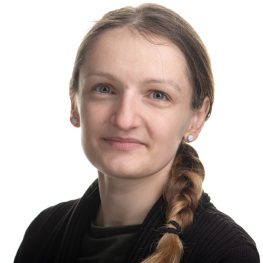
Mina Fanea-Ivanovici is a PhD professor (Habil.) in the Department of Economics and Economic Policies, qualified to supervise doctoral theses in Economics. She obtained her PhD in Economics in 2010 from ASE Bucharest, her Master’s degree in Finance and Management Control from the University of Orléans and ASE Bucharest (2008), her Bachelor’s degree from ASE Bucharest (2006), her Bachelor’s degree from Universite Paris XII Val-de-Marne (2005). She obtained the Best Reviewer 2020 distinction from the journal Engineering Economics (indexed by Clarivate Analytics), Top Peer Reviewer – Publons (2019), the Georgescu-Roegen Diploma (2019) for excellent scientific research. She was part of scientific and organizational committees in scientific events, such as: ICBE, ICESS, ASECU.
She serves as a reviewer for journals such as: Engineering Economics, International Journal of Emerging Markets, Journal of Open Innovation, Smart Cities, Space and Culture, Journal of Sociology and Social Policy, Journal of Consumer and Retail Services, reviewer and evaluator for research projects at the National Science Center of Poland and the Israel Science Foundation. She has edited two specialty books published by Routledge and Springer Nature, respectively. She acted as a juror at the 2024 Fintech Awards Gala and coordinates the OECD Laboratory (FABIZ, ASE, since May 2024). She has been a member or director of six research projects and coordinates the ASE team within an Erasmus+ project. She also followed a postdoctoral research program.
In 2024, she was part of the problem committee of the International Economics Olympiad. She initiated various collaborations with foreign universities and was a speaker at the University of Gdansk in 2023 on the topic of crowdfunding in Central and Eastern Europe. In 2006, she worked as an independent expert for the Ministry of Culture and was in charge of revisiting Romania’s strategy for culture and national heritage. Her research topics include the creative-cultural economy, educational economics, digitalization, alternative finance and crowdfunding. In teaching Economics, she strives to equip students with economic thinking principles and critical thinking.